Coffee Explained
Deconstructing the terminology!
SPECIES
COFFEA ARABICA
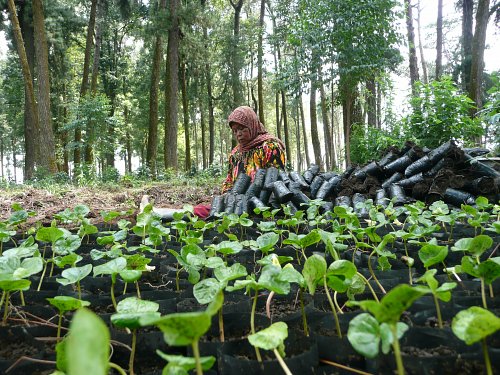
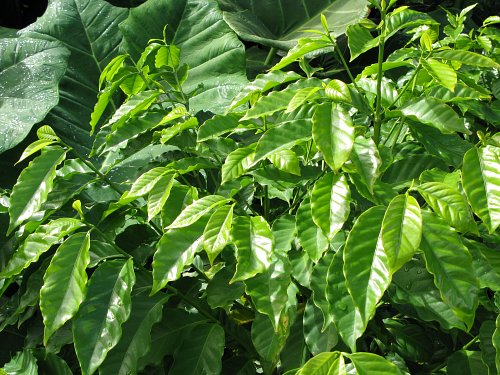
- Undeniably the world’s favourite coffee bean, Arabica is celebrated for its bright, sweet and complex flavour profile; marked by elegant acidity and a balanced body. It has the widest range of varietals, each selectively cultivated to thrive in diverse local environments. Arabica and its counterpart Robusta both belong to the Rubiaceae plant family, which encompasses over 6,000 genera and subfamilies.
COFFEA CANEPHORA
- Commonly known as Robusta, this resilient species has earned growing respect in specialty circles. Standouts like Indian Kaapi Royale – the only Robusta to receive the SCAA’s prestigious ‘Fine Cup’ grading—are redefining expectations. There’s even a dedicated Robusta Q Cupper certification, underscoring its rising status. We proudly stock a selection of Robusta beans sourced from India, Mexico, Tanzania, and Vietnam.
ARABICA VARIETALS
Typica-Based Varietals
- Arusha – A Typica variety grown in Tanzania and Papua New Guinea.
- Blue Mountain – A Typica cultivar grown in Jamaica, Papua New Guinea, Hawaii, Kenya, and Haiti.
- Maragogype (or Maragogipe) – A Typica mutation from Bahia, Brazil, known for its large bean size.
- Mundo Novo – A natural hybrid of Bourbon and Typica, widely grown in Brazil.
- Typica – One of the oldest Arabica lines, originating from Yemen, then spreading to India, Indonesia, and beyond. Includes subtypes like Kona, Blue Mountain, and Kents.
Bourbon Lineage
- Bourbon – Named after the island now known as Réunion. First cultivated by the French, then introduced to Brazil, now grown across South and Central America.
- Caturra – A natural mutation of Bourbon, developed in Brazil in 1937. Compact, high-yielding, with good branch structure.
- Catuai – A hybrid of Mundo Novo and Caturra, developed in Brazil in the 1940s.
- Pacas – A spontaneous Bourbon mutation discovered in El Salvador.
- Pacamara – A hybrid of Pacas and Maragogype, known for its large beans and complex cup profile.
Hybrids & Crosses
- Catimor – Developed by the Portuguese in 1959, combining Timor Hybrid and Caturra.
- Sarchimor – A cross between Villa Sarchi (Costa Rica) and Timor Hybrid.
- Hybrido de Timor – A cross between Coffea Arabica and Coffea Canephora (Robusta).
- Ruiru 11 – Developed in Kenya, released in 1985 for disease resistance. Early versions were bland, but newer hybrids have improved cup quality.
- S795 – Released in the 1940s, a cross between Kents and S288. Widely grown in India and Southeast Asia.
Ethiopian Heritage
- Harrar, Sidamo, Yirgacheffe – Indigenous Ethiopian varietals named after their regions and trademarked by the Ethiopian government.
- Geisha (Gesha) – Originates from Gesha village in Ethiopia, made famous by its cultivation in Boquete, Panama. Also grown in Indonesia. Some believe the Panamanian Geisha traces back to Tanzania.
- Ethiopian coffees are sometimes referred to as Landrace or Heirloom. Landrace is the more precise name, referring to wild or semi wild coffees. It’s estimated Ethiopia has over ten thousand landrace varieties, many of which are still unnamed.
Regional Highlights
- SL28 & SL34 – Two iconic Kenyan varietals developed by Scott Agricultural Laboratories (SL = Selection). Known for bright acidity and complex profiles.
- Sulawesi Toraja Kalossi – Typically the S795 varietal, grown at high altitudes on Sulawesi Island, Indonesia.
SPECIALTY COFFEE
By the official SCA definition, specialty coffee is any coffee that scores 80 points or above using the Q Grading protocols—a system designed to provide consistent, objective feedback to farmers and producers, whether the cupper is in Singapore, Sydney, or Nairobi.
That said, “specialty” is a term that means different things to different people. It’s often used loosely, and its interpretation can vary widely across the industry.
At Coficom, we set the bar a little higher. For us, a coffee must score 84 or above to be considered by us as a specialty and more importantly, it must have a standout flavour that drives the score. While scores are a helpful guide, our strongest recommendation is simple: trust your taste.
Beyond Specialty: Understanding Coffee Grades
Coffees that don’t meet the criteria for Specialty Grade (scoring 80+ on the cupping scale) fall into two main categories:
- Premium Grade: These coffees may not qualify as specialty, but they can still taste excellent and perform well in quality blends.
- Exchange Grade: A more commercial classification, often used in blends where cost is a key factor.
In Kenya and Tanzania, you’ll also come across the term “Grinders”—coffees with a higher defect count, inconsistent screen size, and cupping scores below 80. While not suitable for premium applications, they can be ideal for blends where price sensitivity matters.
ALTITUDE & QUALITY
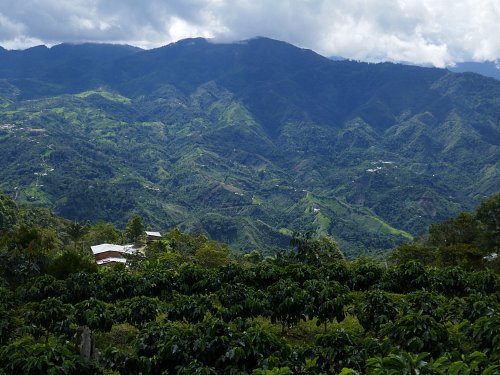
- As a general rule, the higher the altitude, the denser the bean structure. This density contributes to a more refined cup, as beans grown at elevation tend to ripen more slowly, allowing sugars to develop gradually and resulting in greater flavour complexity and brightness.
- Local environmental factors, including soil composition, climate, and farming practices also play a vital role in shaping the final taste profile. While high-grown Arabicas are often prized for their nuance and acidity, it’s worth noting that some low-altitude Arabicas can still deliver impressive body and flavour.
- Altitude is typically shown as MASL – Metres Above Sea Level – key indicator of growing conditions and potential cup character.
ORIGIN COFFEE GRADES
Explaining each origin’s grading would require its own website. Here’s a selection that you’ll see on our coffees-
BRAZIL
As the largest grower there are numerous Brazilian classifications. Here’s the main ones we use:-
SS – Strictly Soft. Best defined as a typical, sweet coffee. As opposed to Hard or Rio like.
NY2/3 – Stands for New York, 2/3 is a grade that allows for 9 defects. Also known as Extra Prime.
GC/FC – Good Cup and Fine Cup; used to describe Strictly Soft Brazilian coffees. Very little difference between the two, classified by the tasters in origin.
Grsh – Green/greenish. Indicates fresh crop.
Grinders – Screen 13 with a set number of defects. Good blending coffee.
MTGB – Medium To Good Bean size, screen size 15 – 16
COLOMBIA
Colombia has set Excelso as the minimum standard for coffees to carry the 100% Colombian Coffee logo as a guarantee of origin and quality. What this means is that coffee bags will be marked as Excelso [Screen size 14 up] indicating it has met the required quality standard on one side but on the other side could be marked Supremo [Screen size 17]
EP – European Preparation. Means that green beans are hand sorted prior to export.
COSTA RICA
HB – Hard Bean, grown at 800 – 1100 MASL [Metres above sea level]
HGA – High Grown Atlantic. Grown at 900 – 1200 MASL
SHB – Strictly Hard Bean. Grown at 1200 – 1650 MASL. Usually coffees from Central Valley and Tarazzu
EP – additional hand‑sorting of green coffee beans after mechanical or optical sorting
ETHIOPIA
UG – UG, or Ungraded, refers to coffee beans that have not gone through the formal grading process or may not meet the criteria for higher-grade classifications.
GUATEMALA
SHB – Strictly Hard Bean. Between 1600 – 1700 MASL
EP – European Preparation. Screen 15 Plus with low defect count
HONDURAS
HG – High Grown, grown at 1000 – 1500 MASL
SHG – Strictly High Grown, grown at 1500 – 2000 MASL
EP – European Preparation. Screen 15 Plus with low defect count
INDONESIA
TP – Triple Pass. Coffee that has been hand sorted three times.
WIB – West Indische Bereiding old Dutch term that refers to the better standard of preparation. Applies to Robusta.
AP – this has numerous meanings but essentially means the coffee has been dry processed. Applies to Robusta.
INDIA
MNEB – Mysore Nuggets Extra Bold, top grade Indian coffee
PLT – Plantation, Premium grade washed coffees.
A Grade – Screen 17
B Grade – Screen 15
Cherry – Naturally processed Arabica/Robusta
KENYA
AA Grade – Screen Size 17 & 18
AB Grade – Screen Size 15 & 16
FAQ – Fair Average Quality, Normally screen sizes 17 and 18.
MEXICO
HG – High Grown, Up to 1600 MASL. Known as Altura
EP – European Preparation. Strict sorting
NICARAGUA
SHG – Strictly High Grown – grown at 1200 MASL and above
EP – European Preparation; strict sorting with a Screen Size of 15+
PERU
MCM – Machine Cleaned Mejorado. Strict machine sorting and grading for export
HB – Hard Bean, normally from 750 – 1900+ MASL
PAPUA NEW GUINEA
PNG launched new standards in 2021 to streamline classifications
A Grade – Blueish green beans. 10 defects per 1kg
X Grade – Even, green to bluish. 30 defects per 1kg
Y Grade – Pale green to green. 70 defects per 1kg
Y2 Grade – Mixed light green to green. 150 defects per 1kg
Y3 Grade – Mixed bean colours, 30% defects by weight
Still being used are a C Grade, usually between an X and Y1. Some coffees are also still marked as PSC, standing for Premium Smallholder Coffee. Normally indicative of a good coffee.
EL SALVADOR
SHG – Strictly High Grown. 1200 MASL
TANZANIA
AA Grade – Screen Size 18
AB Grade – Screen Sizes 15.5 – 18
UGANDA
AA Grade – Screen Size 17 [90%]
AB Grade – Screen 16 [60%] Up
Bugisu – Washed Arabica grown in Eastern Uganda
Drugar – Dried Ugandan Arabica – Naturally processed
WASHED OR WETPROCESS
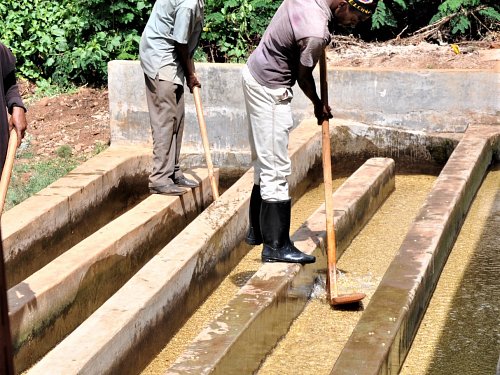
The Washed Process, also known as the Wet Process, begins with freshly picked coffee cherries having their outer skin removed using a de-pulping machine, ideally within 12 hours of harvest to preserve quality.
The beans, still coated in sticky mucilage, are then placed in open fermentation tanks, typically made of concrete and filled with water. Over 12 to 48 hours, a natural fermentation breaks down the remaining fruit residue. Once fermentation is complete, the beans – still encased in their parchment layer – are rinsed and moved to the drying stage.
Water Use & Sustainability
This method requires a reliable supply of fresh water, as tanks must be refreshed every 3–4 cycles to prevent tainting. In the past, enzyme-rich wastewater was often discharged into rivers, causing significant environmental damage.
Today, many coffee producing regions have adopted more sustainable practices:
- Used water is diverted to drying pans, where it evaporates and leaves behind organic sludge that’s dried and repurposed as fertiliser.
- Dried cherry skins are also collected and offered to farmers as mulch, reducing waste and enriching soil.
SEMI-WASHED
Also known as Pulped Natural. Cherries are hulled and the beans then dried in the sun. Much the same as natural coffees, sugars are absorbed into the beans from the remaining fruit on the bean. There are number of variations of semi washed, the most popular being Honey process.
HONEY PROCESS
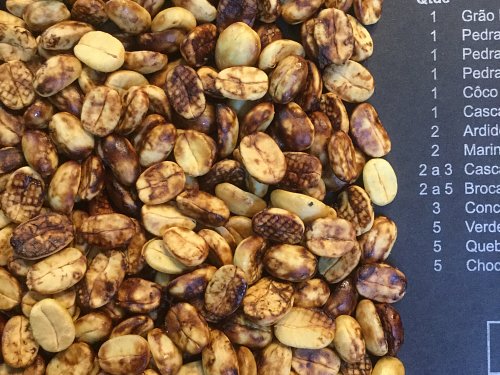
Much the same as semi washed, cherries are pulped then sun dried with as much mucilage or fruit remaining on the bean. As beans dry in the sun, the mucilage darkens. There are a number of variations such as Black Honey, Red Honey, Black Honey, Yellow Honey, 30% Honey and 40% Honey. Most depend on the time taken to dry and exposure to sun. A coffee processed this way will have a lovely, bright sweetness to it created by the sugars being absorbed from the mucilage into the bean.
ANAEROBIC COFFEE
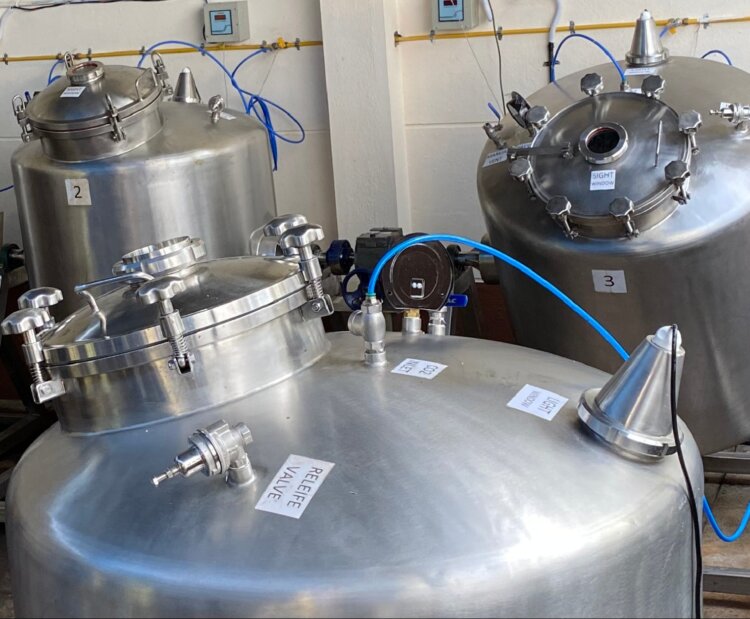
Anaerobic coffee refers to coffee beans that have been processed using anaerobic fermentation, a method where the coffee cherries are fermented in sealed, oxygen-free tanks. In this microbial environment, usually dominated by lactic acid bacteria, the sugars and acids break down in ways that create distinctive flavours.